The following screenshot from Google Search Console shows how a site built entirely on AI content grew steadily for three months this year, from around 300 clicks/day in late May to more than 1,700 clicks/day by early August. This could only be seen as a huge success…until it wasn’t. Within the span of a few days, both clicks and impressions collapsed to almost nothing.
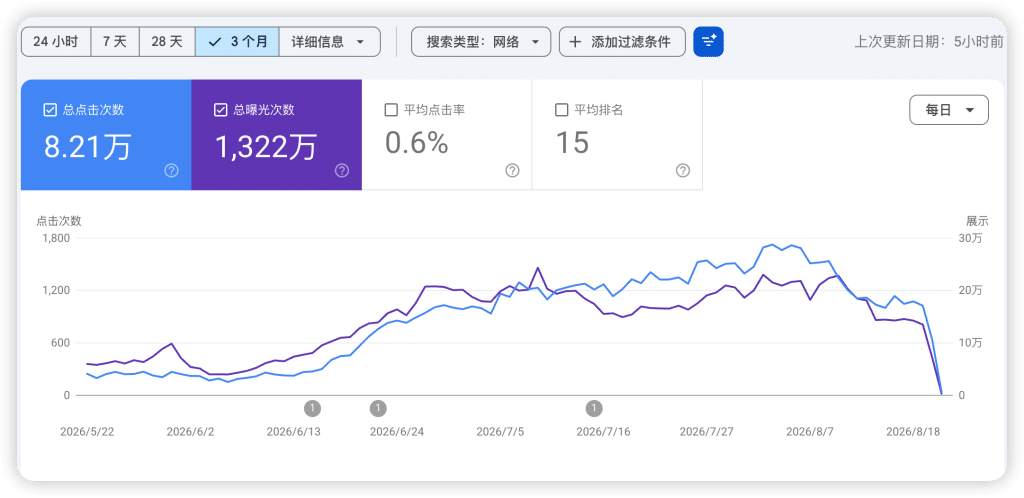
The drop occurred between August 18 and August 21 when Google rolled out its August 2026 spam update,, specifically targeting what it calls scaled content abuse.
That graph is not an isolated case. Lily Ray, a well-known SEO consultant and industry commentator, tracked more than 220 websites that leaned heavily on AI content and found that over half lost at least 30 percent of their peak organic traffic. Separately, Neil Patel, founder of NP Digital, ran a controlled test comparing raw AI content against AI content with human editing. The edited content earned 444 percent more traffic and held up far better against Google updates.
We don’t think that this is an argument against using AI. But it is a very strong argument for keeping a human in the loop before anything is published. And it is definitely a warning sign to avoid scaling content using pure AI.
But isn’t everyone using AI?
Yes, most content published now is at the very least AI assisted.
Patel’s own analysis of the market found that AI now writes roughly 52 percent of new web content, yet earns only about 4.9 percent of organic traffic. Content that gets a light AI-assisted touch-up, short of a full edit, makes up 27.4 percent of what’s published and earns just 8.1 percent of traffic. Human-written and human-edited content is only 14.5 percent of what’s published, but it takes 87 percent of the traffic.
Readers and search engines are already treating raw AI output as low value. Publishing more of it does not change that ratio. It just adds more pages competing for the same small share.
Google has been targeting thin generic content for years
Google’s spam policies define scaled content abuse as pages generated “for the primary purpose of manipulating search rankings and not helping users,” regardless of how those pages were produced. Google formalized this as its own policy in a March 2024 update to its core ranking system and spam policies, aimed at cutting unhelpful, unoriginal content from search results.
Ray’s research shows what that update looks like in practice. Across her sample of 220-plus sites, sites that leaned into AI content followed the same arc: rapid page growth over six to twelve months, a traffic peak three to six months later, then a steep decline within the following year. She identified eight recurring content types among the sites that fell hardest:
- Comparison pages produced at scale
- Programmatically generated glossary or “what is X” entries
- “Best X for Y” listicles
- Pages where a company ranks its own product first
- Dedicated pages built for every competitor
- Location or language pages with barely any unique content between them
- FAQ pages split one question per URL
- Content unrelated to the publisher’s business, built purely to capture search volume
Most declining sites were running three or four of these patterns at once. To be clear these topics are not inherently bad, they are just the commercial topics that are mostly commonly targeted at scale by aggressive AI content campaigns.
A human in the loop added 444% more traffic
Patel’s test involved 744 articles across 68 real websites in different industries, matched on topic and keyword difficulty. Half went live exactly as the AI wrote them. The other half got one human editing pass first, and that pass was the only difference between the two groups.
The edited group earned 444 percent more traffic, 5.44 times as much, and the gap widened over time rather than closing.
The clearest test came when both groups lived through an actual Google update. The unedited sites lost roughly 17 percent of their traffic. The edited sites lost about 6 percent, roughly a third of the damage, from the same update on the same day.
Google’s own guidance on this is consistent with what both studies found. Its documentation on generative AI content states plainly that “using generative AI tools or other similar tools to generate many pages without adding value for users may violate Google’s spam policy on scaled content abuse.”
There is no blanket penalty for AI-written content, but there is a filter for low value content published at scale, i.e. that adds nothing a reader could not get elsewhere.
Detection of AI content is trivial with all major frontier models watermarking generative content. Google’s own system, SynthID, embeds an invisible marker in AI-generated text, images, audio and video. Patel’s research notes that comparable watermarking is now built into output from OpenAI, Anthropic, Nvidia, ElevenLabs and Microsoft, among others, which means the origin of a piece of content is identifiable to a search engine even when it reads cleanly to a person.
So, how should we use AI effectively in our content process?
We recommend using AI for research, outlining and even drafting, but strongly recommend against publishing anything without a human editorial step. AI speeds up the parts of the work that used to take the most time, but it is the human editorial steps that actually determine whether a piece performs over the long term.
In our own processes we use AI to:
- Pull keyword and prompt research, including People Also Ask data, to inform the topic.
- Analyze the articles currently ranking well to see which subtopics, keywords and entities they cover.
- Review competing pages to find information gaps, things a reader would want that the top results leave out.
- Find relevant industry statistics and data worth citing.
- Research Reddit and similar platforms for the concerns of, and language used by real consumers.
- Build an outline that reflects all of the above.
With these inputs, AI can help produce a first draft and run it through structured quality checks for brand adherence, factual and product data accuracy, and natural language readability. But the next step is critical…
The human touch
Before any content goes live it must be reviewed by a human editor. This is the step that will differentiate your content from pure AI generated content, increase your chances that the piece performs well, and protect you from Google’s scaled content abuse filters.
Specifically the human editor should be looking for the following:
- Make sure that the blog has a proper author with a real bio. Putting a real name to the content is a green flag for Google.
- Opportunities to include genuine topic expertise from named spokespeople, e.g. product managers, founders, industry experts.
- Opportunities to incorporate proprietary data that can not be found elsewhere online, e.g. unique consumer research or product data.
- Opportunities to include unique case studies that can’t be found elsewhere online.
- Opportunities to include customer reviews, testimonials and first person quotes.
Google is not so concerned with how content is drafted (unless a scaled content abuse filter is triggered), but they are concerned with how genuinely unique and useful the content is.
Pure AI content is by definition not at all unique because it is the average of all the content the LLM was trained on. The human editor’s job is to make it more unique by adding a layer of valuable and differentiable data and insight.
So what is the main takeaway?
The businesses with the best performing content strategies in the future will not avoid AI altogether. They will use it to work faster without removing the parts of content production that earn a reader’s trust: real expertise, original information, and someone accountable for what gets published under their name.
If you want a second opinion on whether your current content strategy would hold up against an audit like the ones described here, that is a conversation we are happy to have.